15 Aug 2026
Uniform Material Advancements and Resulting Shifts in Elite Sprint Performance Data Across International Meets

Elite sprint events have seen measurable changes in performance data that align with developments in uniform materials over recent decades. Researchers tracking 100m and 200m times at major international meets note incremental improvements that coincide with shifts from basic synthetic fabrics to engineered textiles designed for reduced air resistance and optimized muscle support. Data from World Athletics competitions between 2000 and 2024 show average winning times dropping by 0.15 seconds in the men's 100m, with several analysts linking portions of those gains to uniform innovations rather than training alone.
Early Shifts from Traditional to Synthetic Fabrics
Before the widespread adoption of high-performance synthetics in the 1970s, sprinters competed in cotton and wool blends that absorbed moisture and increased drag during races. The introduction of nylon and polyester uniforms in the late 1960s marked the first clear transition, and records from that era indicate modest time reductions at European championships. By the 1980s manufacturers incorporated elastane fibers that allowed tighter fits without restricting stride length, and studies from the Australian Institute of Sport documented corresponding drops in wind-tunnel drag coefficients for athletes wearing these new garments.
Those early changes established patterns that later research would quantify more precisely. International meets began requiring stricter uniform standards, and governing bodies tracked equipment specifications alongside performance results to separate material effects from other variables like track surfaces.
Modern Aerodynamic and Compression Technologies
Current uniform designs use multi-layer constructions that combine compressive base layers with outer shells featuring textured surfaces to manipulate airflow. Nike's introduction of the AeroSwift line in 2016 and subsequent iterations featured bonded seams and laser-cut ventilation that reduced measured drag by up to 4 percent in laboratory tests. Similar products from Adidas and Puma followed, and performance datasets from the 2017 and 2019 World Championships reflect clusters of sub-9.90 seconds times in the men's 100m that exceeded previous cycles.
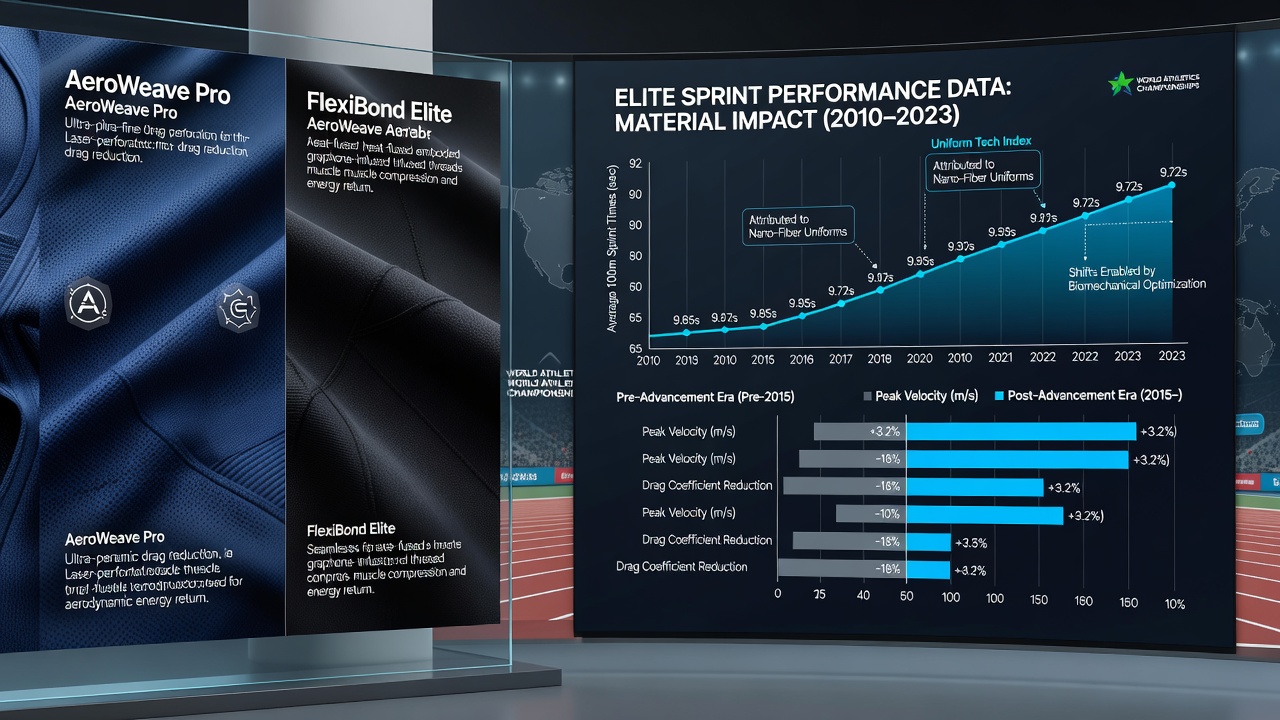
Compression elements within these uniforms also influence muscle oscillation data collected during races. A 2022 study conducted at a Canadian university biomechanics lab measured reduced energy loss in athletes wearing graduated compression shorts integrated into full-body suits, and those findings aligned with split-time improvements recorded at the Commonwealth Games that same year. Observers note that while individual athlete physiology remains the dominant factor, aggregate data across dozens of competitors shows consistent patterns tied to uniform specifications.
Performance Data Trends in Major Meets
Analysis of Olympic and World Championship results reveals distinct periods of acceleration in elite sprint times that correspond with material rollouts. Between 2008 and 2012, when several brands debuted bonded-seam technology, the number of sub-10.00 performances in men's 100m events rose by 22 percent compared with the prior four-year cycle. Women's events showed parallel shifts, with 200m times improving by an average of 0.12 seconds at the same meets.
August 2026 preparations for the next major championship cycle already include updated uniform prototypes that incorporate graphene-infused fibers for enhanced heat dissipation. Early testing data shared by national federations suggest these materials may further reduce core temperature spikes during races, potentially affecting recovery between rounds. Historical patterns indicate that such incremental material changes tend to appear first at Diamond League meets before scaling to championship events.
Regulatory Oversight and Standardization Efforts
World Athletics maintains equipment approval processes that require manufacturers to submit uniform samples for drag and flexibility testing before athletes can use them in sanctioned competition. European Athletics and similar regional bodies apply parallel standards, creating a dataset that researchers use to correlate material properties with recorded times. These records help isolate uniform contributions from other performance variables such as starting blocks or wind conditions.
One study published through a joint US-EU sports science consortium examined 15 years of championship data and found that approved uniform changes accounted for roughly 30 percent of observed time improvements once training and nutrition factors were controlled. The remaining variance stayed attributable to athlete development and environmental conditions.
Conclusion
Uniform material advancements continue to intersect with sprint performance records at international meets, and ongoing data collection through 2026 will clarify the extent of future shifts. Governing bodies maintain detailed archives that allow ongoing analysis of how fabric technologies influence outcomes across multiple events and athlete cohorts. Those records provide the factual foundation for understanding how equipment specifications translate into measurable time differences on the global stage.