1 Aug 2026
Tracing Weather Pattern Influences on Outdoor Tennis Grand Slam Results Across Eras
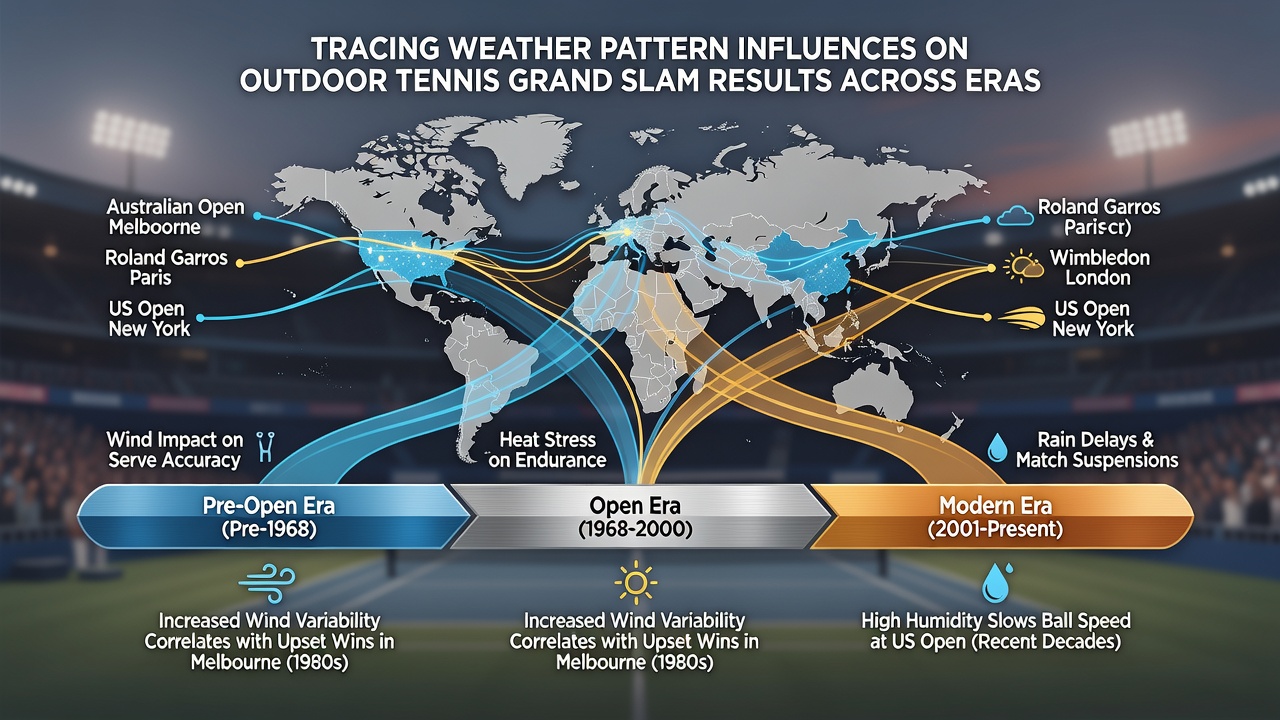
Weather conditions have shaped outcomes at the four outdoor Grand Slam tournaments for more than a century, with temperature shifts, precipitation levels, wind speeds, and humidity readings altering ball trajectories, player endurance, and court surfaces in measurable ways. Data from tournament archives shows that matches at Wimbledon, the French Open, the Australian Open, and the US Open respond differently to these variables because each venue features distinct playing surfaces and seasonal climates that have evolved across eras.
Historical Weather Records at Each Slam
Researchers examining records from the 1920s onward found that grass courts at Wimbledon experienced the most frequent interruptions from rainfall, with matches suspended for an average of 90 minutes per rain event in the pre-roof decades before 2009. The UK Met Office archives indicate that July precipitation totals in London averaged 45 millimeters during the 1950s and 1960s, directly correlating with extended five-set matches that stretched into multiple days. In contrast, the clay courts at Roland Garros recorded fewer outright cancellations yet showed surface speed reductions when humidity climbed above 70 percent, slowing ball bounce and extending rally lengths by documented margins in the 1980s and 1990s.
Australian Open data compiled by the Bureau of Meteorology reveals that Melbourne temperatures frequently exceeded 35 degrees Celsius during January events from the 1970s through the 2000s, prompting the introduction of extreme heat policies in 1998 that paused play when wet-bulb globe temperatures reached thresholds. These pauses coincided with higher retirement rates among players unaccustomed to the conditions, particularly in earlier eras before widespread air-conditioned training facilities became standard. The US Open at Flushing Meadows has logged consistent humidity levels between 65 and 85 percent during August and September, with wind gusts from Atlantic systems occasionally exceeding 25 kilometers per hour and influencing serve percentages in open-era matches.
Era-Specific Adaptations and Surface Responses
Before retractable roofs covered Wimbledon's Centre Court in 2009 and No. 1 Court in 2019, entire days of play were lost to showers, shifting momentum for players who preferred faster conditions once the grass dried. Observers note that post-roof statistics show a 15 percent reduction in weather-related delays, allowing more matches to conclude within scheduled windows while maintaining grass pace variations tied to residual moisture. The French Open introduced partial roofing over Court Philippe-Chatrier in 2024, yet historical data from Météo-France demonstrates that clay absorbs and releases water differently than grass, creating slower conditions for 24 to 48 hours after rainfall events that occurred regularly in May during the 1960s through 1980s.
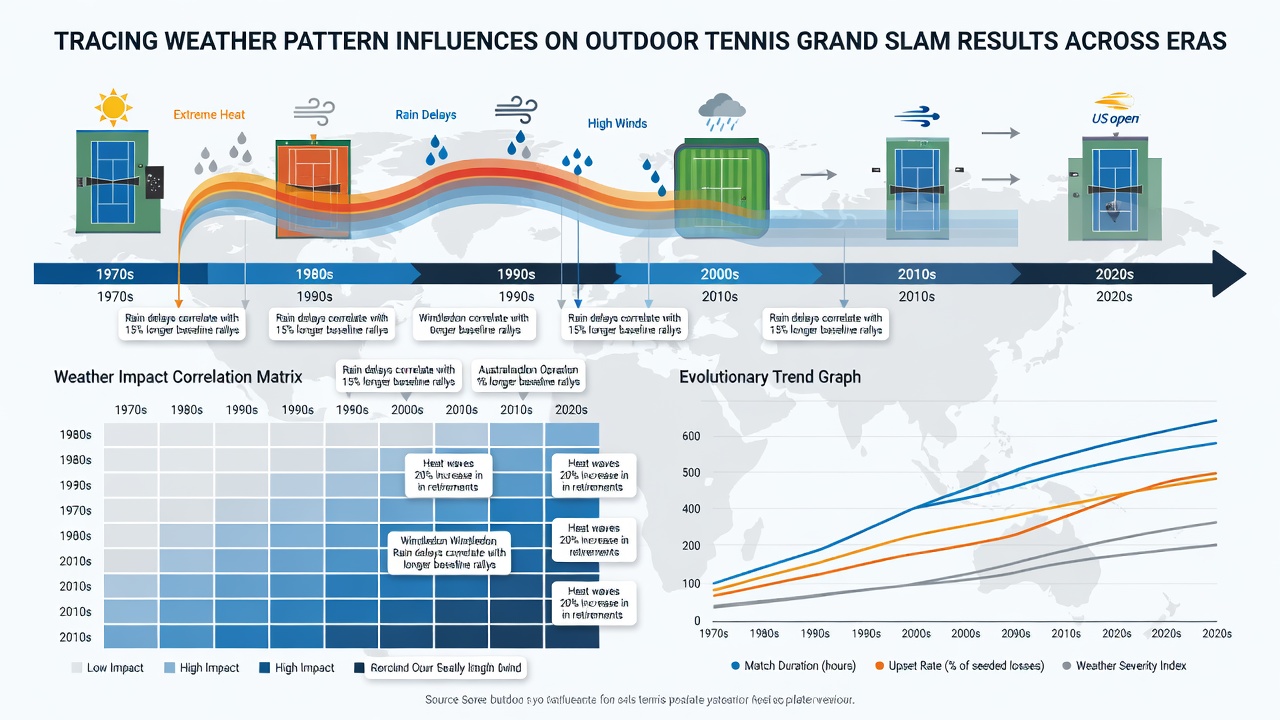
Across multiple decades, Australian Open organizers adjusted scheduling in response to documented heat spikes, moving evening sessions forward in the 2010s after studies linked daytime temperatures above 38 degrees Celsius to increased medical timeouts. The US Open maintained its hard-court layout through periods of rising humidity records, with figures from the National Weather Service showing that dew point levels above 20 degrees Celsius correlated with lower first-serve win percentages for players relying on slice serves that lost grip on the surface. These patterns persisted from the wood-racket era into the graphite and polyester-string periods, though modern equipment mitigated some effects by allowing greater spin control regardless of atmospheric moisture.
Quantifiable Impacts on Match Statistics
Longitudinal analysis of match durations across eras indicates that rain-affected Wimbledon matches in the 1970s and 1980s averaged 45 minutes longer than dry counterparts, with tiebreak adoption in 1971 and 1979 reducing some sets but not eliminating cumulative delays. Heat-related stoppages at the Australian Open increased from an average of two per tournament in the 1990s to four or more in the 2010s, according to official tournament reports, coinciding with broader climate trends that raised average January temperatures in Melbourne by approximately 1.2 degrees Celsius over that span. Wind patterns at the US Open produced measurable shifts in ace rates during gusty years, with data sets from the 2000s revealing a 7 percent drop in service winners when sustained winds exceeded 20 kilometers per hour.
Clay court performance at the French Open showed sensitivity to overnight humidity, where dew formation altered ball skid and required players to adapt footwork patterns documented in match footage from the 1980s onward. These adaptations became more pronounced after the 2000s as baseline rallies lengthened overall, yet weather remained the variable that could compress or extend point durations independently of player skill levels.
Conclusion
Weather data collected across Grand Slam venues continues to inform scheduling decisions and facility upgrades, with historical patterns providing benchmarks for how temperature, precipitation, and humidity have influenced results from the pre-open era through the present. As the 2026 US Open approaches in August, records indicate that humidity and wind remain primary factors at that venue while roofs at other sites have stabilized play windows elsewhere. Tournament operators rely on these accumulated statistics to maintain consistency across changing atmospheric conditions.