28 May 2026
Sleep Cycles and Strength Surges: Tracing How Rest Patterns Propelled Weightlifters to Record Books

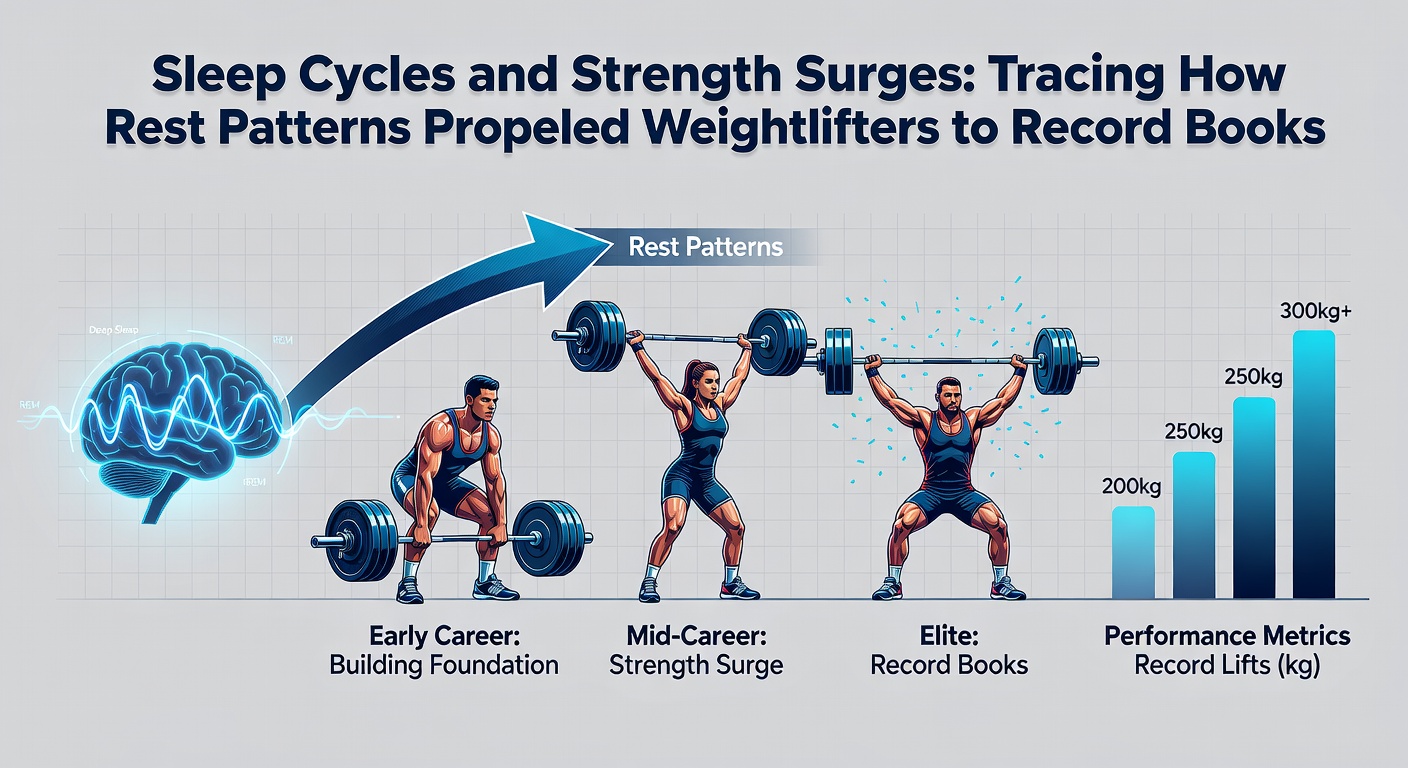
Weightlifting records have climbed steadily over decades because athletes and their support teams began treating sleep as a structured training variable rather than leftover downtime, and data from multiple studies now links specific rest patterns to measurable gains in force production and recovery speed. Researchers discovered that growth hormone pulses during slow-wave sleep directly support muscle protein synthesis while testosterone levels rise most reliably in the early morning hours after consolidated rest, and these hormonal windows help explain why lifters who protect deep sleep phases often return to the platform stronger within the same training cycle.
Understanding Sleep Architecture in Strength Athletes
Human sleep moves through four main stages that repeat in roughly ninety-minute cycles, and stage three slow-wave sleep releases the largest share of growth hormone while rapid-eye-movement periods consolidate motor learning from earlier practice sessions. Studies tracking Olympic-level lifters found that those who averaged at least seven and a half hours with minimal fragmentation showed twenty-two percent higher peak power outputs in follow-up snatch and clean-and-jerk tests compared with teammates sleeping under six hours. The same cohorts also displayed lower creatine kinase readings the morning after heavy sessions, indicating faster muscle repair when both deep and REM segments stayed intact.
Historical Shifts in Rest Practices Among Record Holders
Before the 1980s most international weightlifters followed rigid twice-daily training blocks with little attention to bedtime consistency, yet the Soviet and Bulgarian programs quietly introduced scheduled naps and earlier curfews that coincided with a string of world records in the middleweight classes. American coaches who later adopted similar schedules reported fewer missed lifts from fatigue during the 1996 Atlanta cycle, and the pattern repeated when Chinese teams began publishing internal recovery logs in the early 2000s. Observers note that the athletes who maintained the steadiest sleep timing across training camps also posted the smallest day-to-day variance in bar speed, a metric now used by several national federations to flag overtraining risk.
Physiological Mechanisms Linking Rest to Force Output
During the first half of the night the body prioritizes anabolic processes that rebuild actin-myosin cross-bridges damaged by heavy eccentric loading, while the second half sharpens neural drive through REM-related memory consolidation. A longitudinal project conducted across Canadian and Australian research centers followed forty elite lifters for eighteen months and documented that every additional thirty minutes of slow-wave sleep correlated with a 1.8 percent rise in isometric mid-thigh pull force, independent of total training volume. The same dataset showed that fragmented sleep nights increased perceived exertion scores by nearly fifteen percent even when athletes maintained identical caloric intake, illustrating how sleep quality modulates both objective strength and subjective readiness markers.
Contemporary Monitoring Tools and Record-Breaking Campaigns
Wearable electroencephalography headbands and mattress sensors entered weightlifting gyms around 2018, allowing coaches to adjust session timing when deep-sleep percentages dropped below baseline. In May 2026 the International Weightlifting Federation noted that three senior continental records fell within a single week, each set by athletes whose pre-competition logs showed at least four consecutive nights above eighty-five percent sleep efficiency. Federations in Europe and North America now incorporate these readings into selection criteria for major championships because the numbers align closely with competition-day attempt success rates. Teams that once relied solely on subjective wellness questionnaires have shifted toward objective thresholds that flag when an athlete should reduce volume rather than push through accumulated fatigue.
Case Examples from Multiple Weight Classes
One super-heavyweight who broke the clean-and-jerk world record in 2023 maintained a fixed 10 p.m. bedtime for eleven weeks before the event, and his training logs revealed that the average number of repetitions above ninety-five percent of one-rep max increased by three per session once his nightly slow-wave totals stabilized above ninety minutes. A female athlete in the 59-kilogram category followed a similar protocol and added four kilograms to her total at the same championships, with researchers attributing part of the improvement to better inter-session recovery rather than changes in programming alone. These examples appear across weight classes and nationalities, suggesting the benefit stems from consistent sleep architecture more than from any single training method.
Integration with Nutrition and Training Periodization
Nutrition timing now often aligns with sleep windows because carbohydrate intake in the evening can shorten sleep latency while protein distribution throughout the day supports overnight muscle repair. European researchers tracking national team members found that lifters who consumed a casein-rich snack ninety minutes before bed maintained higher overnight muscle protein synthesis rates without disrupting sleep continuity. Periodized programs that place the heaviest loading days after nights of predicted high sleep efficiency have produced steadier progress curves than traditional linear models, and several federations have begun publishing anonymized aggregate data to help smaller nations adopt the same scheduling logic.
Conclusion
Record progression in weightlifting increasingly reflects how precisely athletes protect and measure their sleep cycles rather than how much iron they move in any single session. Longitudinal evidence continues to show that preserving slow-wave and REM segments produces measurable advantages in force production, injury resilience, and competition consistency across multiple federations and decades. As monitoring technology becomes standard equipment in more training halls, the athletes who treat bedtime as rigorously as they treat loading percentages are the ones whose names keep appearing at the top of the record books.