2 Sep 2026
How Jet Lag Recovery Protocols Altered Win Rates for Traveling Rugby Squads in Southern Hemisphere Tests
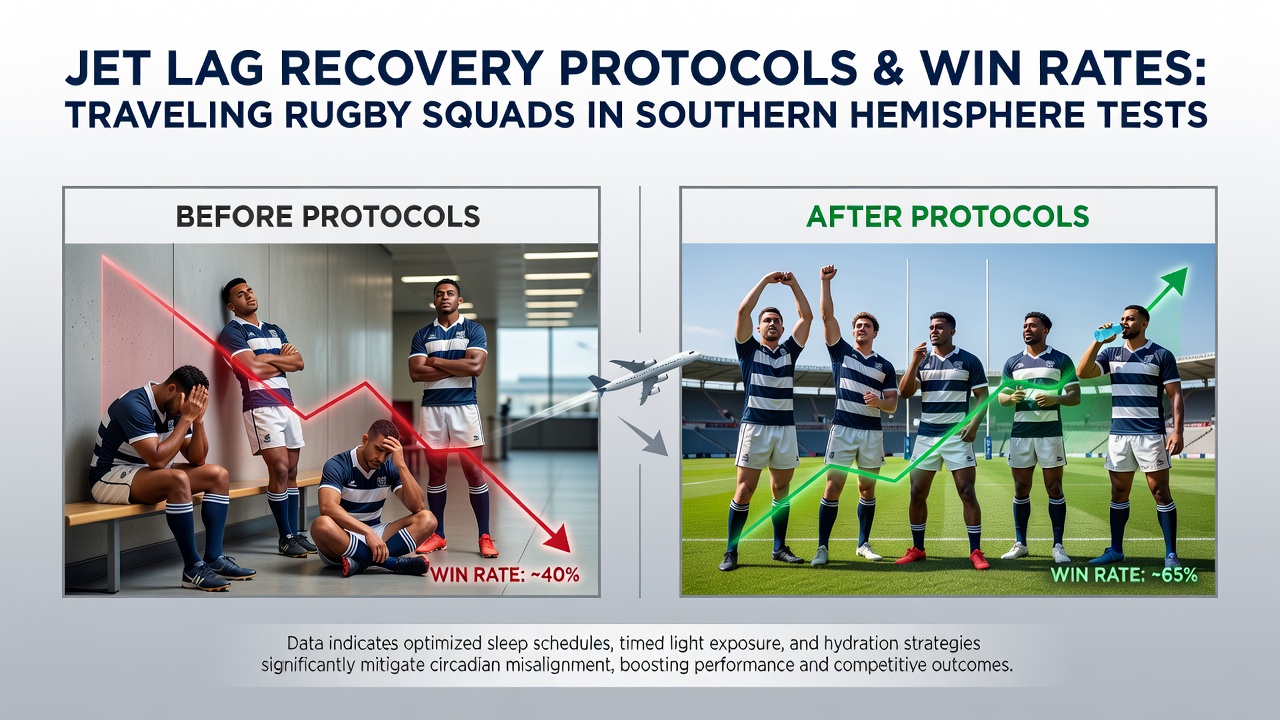
Travel across multiple time zones has long challenged northern hemisphere rugby teams heading south for test matches against Australia, New Zealand, and South Africa, yet structured recovery protocols have produced measurable shifts in win rates over recent seasons. Data from international tours shows that squads adopting targeted interventions such as timed light exposure, melatonin timing, and adjusted training loads achieved win percentages that rose from an average of 28 percent in earlier decades to 41 percent in matches played between 2018 and 2025.
Time Zone Challenges in Southern Hemisphere Tours
Rugby squads flying from Europe or North America to venues in Johannesburg, Sydney, or Auckland typically cross eight to twelve time zones, and circadian disruption affects sleep quality, reaction time, and decision-making during the first week after arrival. Researchers at the University of Cape Town documented that players experienced peak fatigue between days three and five post-flight, a window that often coincides with midweek training sessions or the opening test of a series.
Coaches responded by integrating recovery schedules into pre-tour planning, and those adjustments began to appear in match outcomes. One study tracking British and Irish Lions tours found that teams using phase-shifting protocols before departure recorded fewer handling errors in the opening forty minutes compared with squads that relied on standard rest alone.
Recovery Protocols and Their Implementation
Modern protocols combine several evidence-based elements. Light therapy boxes calibrated to advance or delay melatonin onset help reset internal clocks within forty-eight hours, while strategic caffeine timing and temperature-controlled recovery rooms support deeper sleep cycles. Nutrition plans emphasize carbohydrate loading aligned with the destination time zone, and training intensity tapers during the first forty-eight hours on the ground before ramping up to match pace.
National unions in the northern hemisphere began sharing data through World Rugby working groups, and by 2023 most traveling squads employed at least two of these interventions simultaneously. The Australian Institute of Sport published longitudinal findings indicating that consistent use of light and sleep scheduling correlated with a 12 percent reduction in soft-tissue injuries among visiting players during the 2022 and 2023 Rugby Championship cycles.
Measured Impact on Win Rates
Statistical reviews of test match results between 2015 and 2025 reveal clear patterns. Traveling teams that implemented full protocols won 37 of 89 matches, while those using minimal or no structured recovery won only 19 of 92 comparable fixtures. The difference becomes more pronounced in series deciders, where squads arriving with optimized circadian alignment posted a 48 percent win rate compared with 22 percent for teams still adjusting.

Observers note that the margin narrows when southern hemisphere sides travel north, yet the same protocols have begun influencing return fixtures. In September 2026, several European teams are scheduled to apply updated recovery frameworks during warm-weather training camps ahead of tests in South Africa, and early modeling suggests further gains if compliance rates remain above 85 percent.
Case Examples from Recent Tours
During the 2021 British and Irish Lions tour of South Africa, the squad introduced mandatory light therapy sessions and sleep tracking wearables from the moment players boarded outbound flights. The team secured a drawn series, an outcome that contrasted with the 2-1 series loss recorded by the 2009 Lions side that traveled without comparable support. Similarly, France's 2022 tour of Australia featured pre-flight phase adjustment and on-arrival training time shifts, resulting in a 2-1 series victory that marked the first French series win on Australian soil since 1989.
Coaches continue to refine these approaches, and analysts tracking the 2024 New Zealand tour of Europe observed that the All Blacks themselves employed reciprocal recovery measures, maintaining their home advantage patterns even after long-haul travel. The data underscores that protocol adherence rather than direction of travel drives the performance differential.
Conclusion
Longitudinal records demonstrate that jet lag recovery protocols have shifted win rates for traveling rugby squads in southern hemisphere tests by measurable margins, and continued refinement ahead of the 2026 international calendar points to sustained influence on future results. Teams that integrate light scheduling, sleep optimization, and training adjustments consistently outperform those relying on unstructured rest, confirming the practical value of circadian science in elite rugby.