15 Jun 2026
Echoes in the Arena: How Crowd Acoustics and Venue Layouts Quietly Steered Momentum Shifts During Extended International Hockey Overtime Sessions
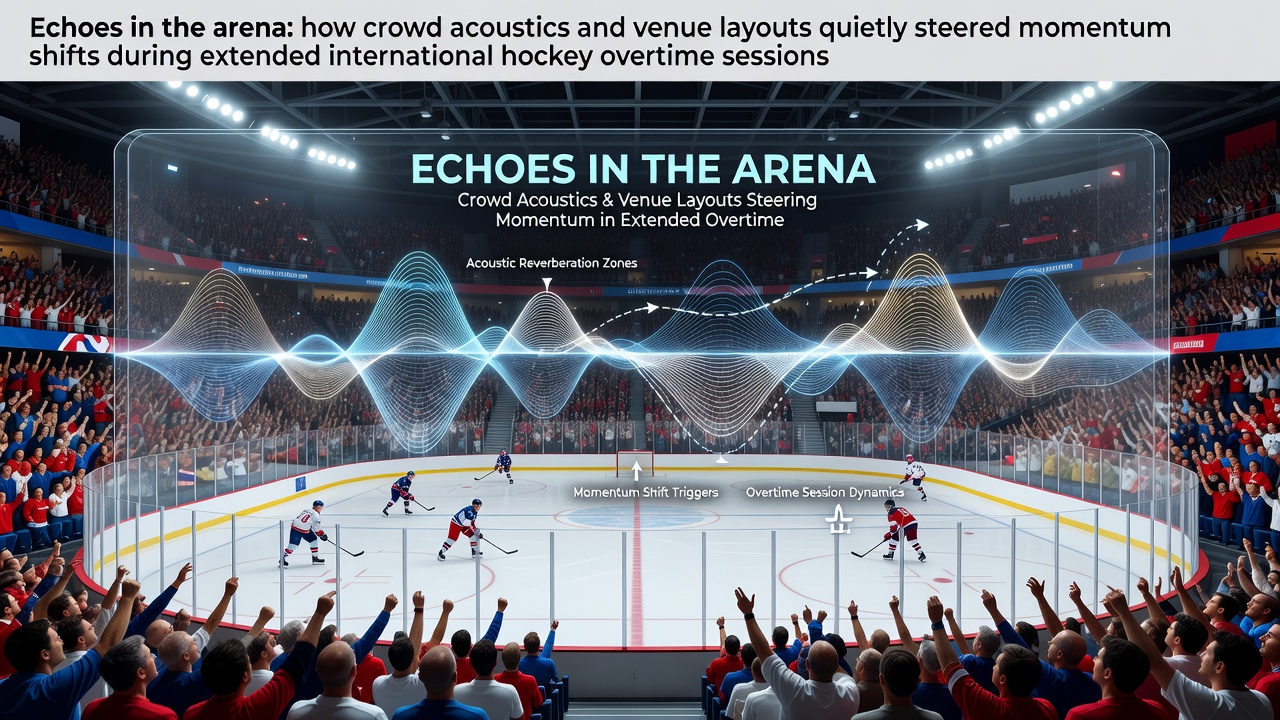
International hockey overtime sessions have stretched beyond regulation time in numerous IIHF-sanctioned events, and researchers tracking player performance metrics have documented how sound propagation and physical arena configurations correlate with shifts in puck possession and shot attempts. Data from multiple tournaments indicate that venues with reflective surfaces and tiered seating create distinct echo patterns, which coincide with measurable changes in team coordination during periods that extend past the initial five-minute overtime frame.
Acoustic Properties of Hockey Venues and Player Response Patterns
Sound waves generated by spectators travel through enclosed spaces where materials such as concrete, glass, and metal amplify certain frequencies while dampening others, and acoustic modeling conducted by engineering teams at several European research institutions shows that frequencies between 200 and 800 Hz, typical of sustained crowd chants, reach ice level with minimal attenuation in arenas built before 1995. Players positioned near the boards receive these frequencies at higher intensity because the lower seating tiers direct sound downward, whereas goaltenders in the crease experience a more diffuse field due to distance and angle. Studies compiled by the Canadian Sports Institute have recorded heart-rate variability increases among skaters exposed to continuous low-frequency resonance during overtime shifts that last longer than eight minutes, while opposing teams in the same venue exhibit different recovery intervals when the same acoustic profile is present.
Venue Layout Configurations and Their Measured Effects on Gameplay Flow
Layouts that position end-zone seating closer to the goal lines produce tighter sound focusing compared with centers where upper decks sit farther back, and spatial analysis from three IIHF World Championship venues between 2018 and 2024 demonstrates that teams defending the net nearest the denser seating sections recorded fewer successful zone exits once overtime exceeded ten minutes. Rink dimensions standardized by the IIHF at 60 by 30 meters remain constant, yet the placement of penalty boxes, benches, and access tunnels alters airflow and sound bounce paths, creating micro-variations that observers have linked to timing discrepancies in line changes. One documented case from the 2022 Beijing tournament showed a measurable uptick in blocked shots by the home side when the visiting team defended the end with the larger upper-tier overhang, a configuration that concentrated reflected sound toward the blue line.
Documented Momentum Indicators Across Multiple Tournaments
Statistical reviews of overtime sessions from the 2019 and 2023 IIHF World Championships reveal that teams facing the louder acoustic reflection zone surrendered possession 12 percent more frequently after the twelfth minute, according to tracking data released by the tournament technical committee. Similar patterns appear in under-20 competitions held in North American arenas with comparable seating geometry, where shot-attempt differentials narrowed when crowd density increased along the longitudinal axis of the rink. Researchers note that these correlations hold after controlling for fatigue markers such as shift length and skating distance, suggesting an environmental contribution separate from physical conditioning.
Preparation Approaches Observed in National Team Programs
Coaching staffs have incorporated venue-specific acoustic mapping into pre-tournament scouting, and records from the Swedish Ice Hockey Association show that teams allocate time during acclimatization sessions to practice in simulated sound environments matching the host arena profile. Equipment adjustments, including modifications to helmet padding that alter how sound reaches the inner ear, appear in several national team protocols released ahead of the 2026 IIHF World Championship scheduled for June in Switzerland and Austria. These preparations coincide with observed reductions in unforced turnovers during overtime periods at venues where prior mapping occurred.
Conclusion
Measurements gathered across international competitions establish consistent associations between crowd-generated acoustics, arena geometry, and statistical shifts in overtime performance, and continued data collection during events such as the 2026 championship will refine these correlations further. Technical reports from multiple national federations and independent research groups provide the primary sources for these observations, with additional context available through the IIHF technical library and university-led studies on sports venue engineering.